
Running Super Bowl Squares with AI

March 11, 2026
At Tag1, we believe in proving AI within our own work before recommending it to clients. This post is part of our AI Applied content series, where team members share real stories of how they're using Artificial Intelligence and the insights and lessons they learn along the way. Here, Mark Felton, Director of Technical and Strategic Solutions, shares how he used AI and Google Sheets to automate a Super Bowl Squares fundraiser for his daughter’s hockey team.
No Car Washes, Just Kickoffs
This year, our team raised $4,000 for my daughter’s hockey team with a Super Bowl Squares fundraiser. While many high school sports and clubs hold car washes, New England winters generally rule out anything involving buckets of water. Instead, our team rallies around the indoor excitement of the Super Bowl.
What are Super Bowl Squares?
For the uninitiated, Super Bowl Squares is a game of chance played on a 10×10 grid.
The rules are simple:
- The rows and columns are randomly assigned numbers 0–9.
- One axis represents the Home team; the other represents the Away team.
- A square wins if its coordinates match the last digit of each team's score at the end of the 1st, 2nd, and 3rd quarters, or the final score.
Each football grid provides four chances to win. For example, if the score at halftime is 17–10, and your name is on the square where 7 (Home) and 0 (Away) intersect, you win that quarter and collect the prize.
Beating the Odds
To raise booster funds for team expenses like equipment, an end-of-season banquet, and coach gifts, we asked the 18 players on the roster to sell 15 squares each at $20 per square. Half of the funds raised go to the pool of prize money, while the remaining half goes into the team kitty. The team exceeded its goal and sold 400 squares, enough to fill four football grids. This year, our 16 winners each took home a $250 prize.
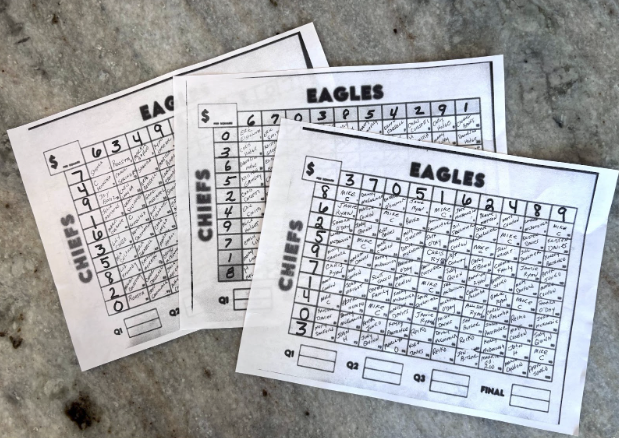
Last year’s grids were handwritten. This year, we used a spreadsheet along with a program to fill the grids programmatically, with a little help from AI.
From Pencil and Paper to Google Sheets with AI
Filling out Super Bowl grids by hand can be a tedious and error-prone process. This year, I was determined to use technology to streamline the logistics of running the fundraiser over several weeks. I set up a Google Form and Google Sheet, both shared with my fellow organizers.
I’ve automated spreadsheet busywork using Google Apps Script in the past, so I figured Gemini could help me generate a script for this task. All my script had to do was collect the names for the squares we sold, batch them into groups of 100, randomize them, and write the names onto the grids.
How hard could it be?
The Challenge of the Grid
Sure enough, Gemini gave me a functional script to generate grids in seconds. Over the three weeks it took to sell 400 squares, my collaborator and I tested the script, but something didn't seem right. While the placement of names was random, it didn't look random. I soon learned that a grid filled randomly isn't always fair.
The idea behind Super Bowl squares is that you follow the game on TV, and update your grid as the game progresses. But not all squares on a football grid are created equal. Because of common scoring increments (e.g. touchdowns, field goals, extra points), digits like 0, 3, and 7 show up far more often in football scores, while 2, 5, and 8 are far less favorable. Nobody wants to draw a 2 or a 5. If your name lands in a row or column with those numbers, it can feel like you've lost before the game even starts.
When grids are filled sequentially or with naïve randomization, names often cluster together. One buyer's squares can end up concentrated in a high-probability row or column, while others are stuck in the unlucky corners. The outcome may be technically random, but it doesn't feel fair. It's hard to explain, but you know it when you see it.
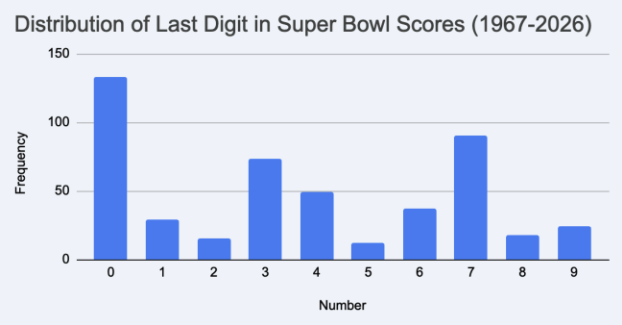
I used Gemini to research the historical distribution of digits in Super Bowl history, and its findings confirmed what I already knew: not all squares are created equal.
Solving the "Fairness" Problem
As a parent volunteer and organizer, I wanted everyone who contributes to the fundraiser to have fun. Many families purchased multiple squares, and while this is a game of chance, ideally their squares should include a mix of favorable and unfavorable numbers. I turned back to AI to revise my script to ensure a fair distribution of names, not just a random one.
After a few iterations, I solved the problem by treating each seller's squares as an affinity group. I established a constraint that no one seller's squares can appear twice in the same row or column. The effect is that related names are spread more evenly across the grid, and everyone gets a shot at good numbers.
For me, the real lesson wasn't about streamlining the process of creating football grids. It was about solving the problems we encountered along the way. I learned that if I can define the problem, AI can help me solve it. I’m looking forward to using AI to solve more problems.
Resources
Ready to run your own football squares fundraiser? I’ve shared my Google Sheet template , including sample data so you can try out the scripts immediately. I've also shared the scripts and historical data covering Super Bowl outcomes on GitLab.
This post is part of Tag1’s AI Applied content series, where we share how we're using AI inside our own work before bringing it to clients. Our goal is to be transparent about what works, what doesn’t, and what we are still figuring out, so that together, we can build a more practical, responsible path for AI adoption.
Bring practical, proven AI adoption strategies to your organization, let's start a conversation! We'd love to hear from you.