
A New Direction for Authentication in Drupal Core
How AI helped me process my thoughts

July 15, 2026
When approaching AI, I've done so warily. Maybe it was because I was a skeptic, but my first endeavors were not glowing success stories. My first real attempt to kick the tires ended with me kicking AI to the curb and doing some regex and search/replace to finish what it started. I chalk it up to a mix of model maturity and, let's be honest, my own ill-directed uses.
But more recently I've been finding wins. I find AI very useful for writing test cases for test-driven development (TDD). It's also really good at troubleshooting. It takes a bug report, follows the code paths, and writes a failing test that reproduces the bug. When you solve the problem, you can be sure you have solved it. And more importantly, that it was even a problem in the first place.
Putting AI to Work on a Real Problem
It was at this point, I realized that AI might be able to help me with my Drupal Core maintainer duties. For those that don’t know, I maintain an insane number of contrib modules and am a core subsystem maintainer in 3 areas, namely migrate, image, and authentication/authorization. The last area of auth/authZ is in desperate need of modernization.
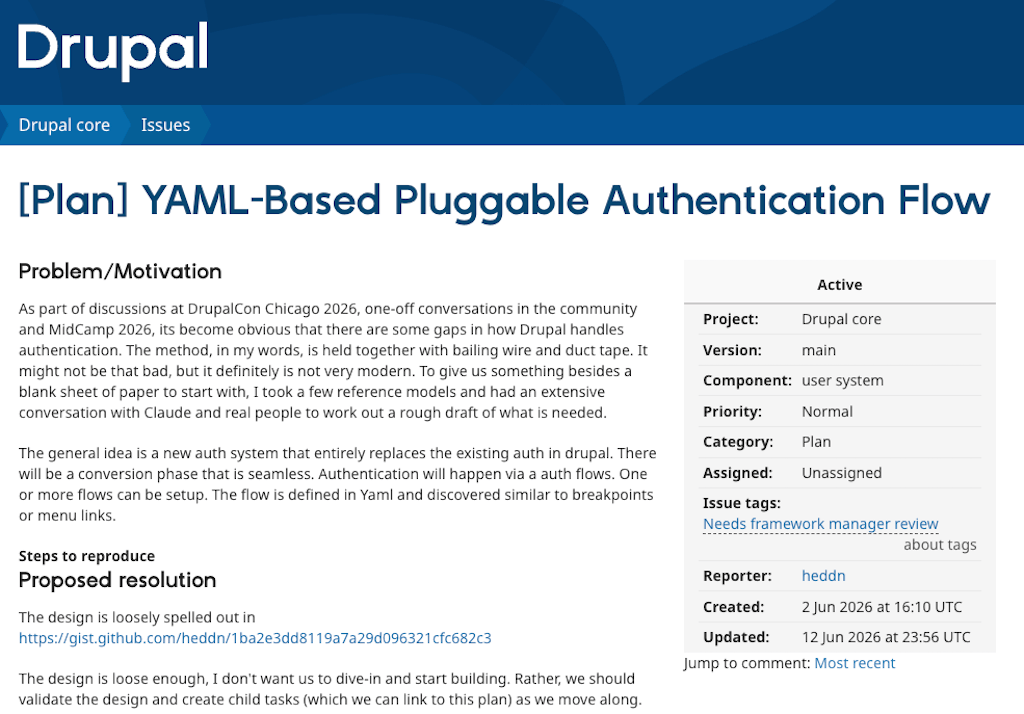
The planning issue requirements and roadmap are all open. The community design review hasn't started yet, so now is a good time to take a look: [Plan] YAML-Based Pluggable Authentication Flow
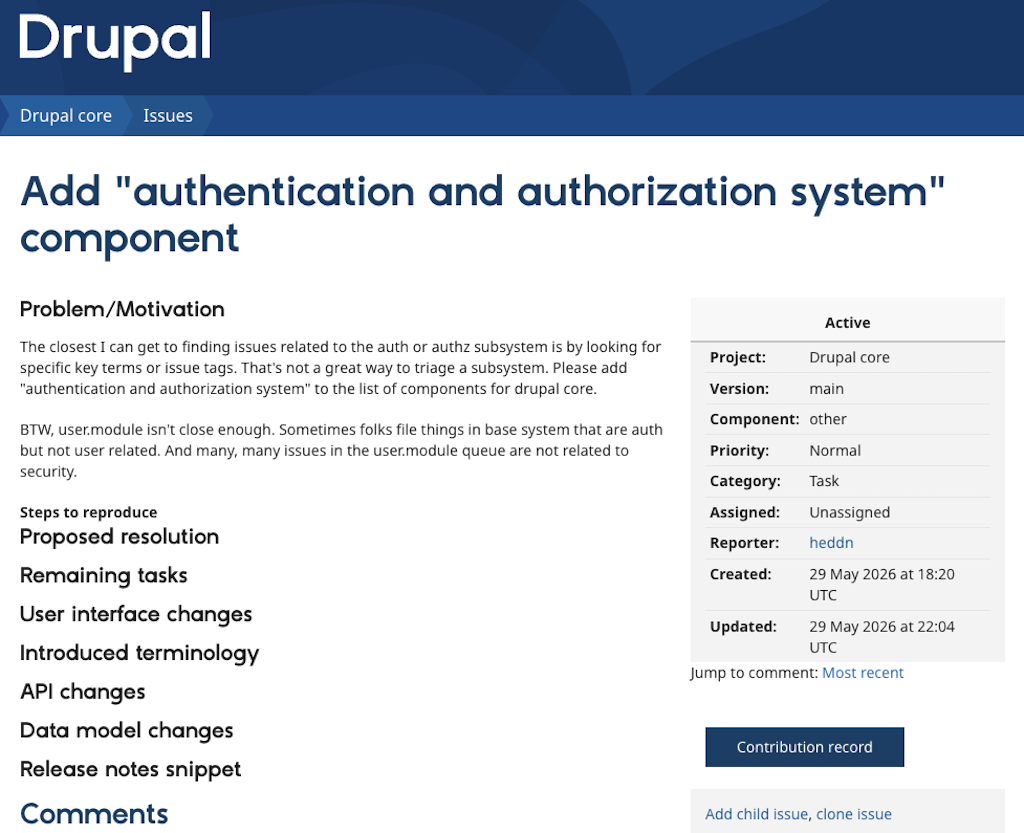
The first part of the problem for auth/authZ is that there aren't any core components in the core issue queue for the sub system. I have to look in a few module queues and the base system to find relevant issues. I filed this issue to establish a dedicated auth/authZ component in the Drupal core queue.
To help me get my mind around the space, I had AI query all 1,200 issues in the module-based issue queues. Then it spun out from there to find referenced issues. I leveraged a local file cache of d.o issues so I didn’t have to hit the drupal.org API repeatedly as I was tweaking the discovery.
This demonstrates the first lesson I’ve learned with AI. It is really good at doing directed research and planning. But you need to give it guard rails. I had to tell it to add a cache. I had to tweak the issue filters. I had to think about what I wanted. AI wouldn’t think for me. But at the end, I had several hundred issues downloaded locally.
Making Sense of 1,200 Issues
Then came the next step. I asked AI to create a mind map using mermaid.live. With over 1,000 issues, I didn’t want something that was too unmanageable. I picked a couple issues that seemed key to me and asked AI to give me a mind map with issues directly related to authentication (excluding authorization for the moment). That shrank things down to just a few hundred. But the large picture of categorized issues in a mind map started to tell a story.
The mind map story led me back to the planning phase again. This time I used BMAD, an AI methodology specifically structured to guide planning a task using AI. I fed it the pain points and asked it to look at some reference PHP and non-PHP authentication frameworks. It researched Laravel, Symfony, Drupal and Keycloak. At this point I had enough data to request it to write some pros/cons and possible pseudo implementations.
Somewhere in this whole process DrupalCon Chicago happened. Then a few weeks later MidCamp in Chicago happened. This gave me ready access to real people to bounce ideas off. They asked some really great questions. I fed these questions back into AI and refined the design even further.
Then more recently, I had the opportunity to speak at a Drupal meetup on Zoom. I took all the data I’d gathered, the mind maps, the design artifacts generated by BMAD and created a nice slideshow presentation. But the source data was from research provided by AI. The attendees at the meetup had even more feedback. I fed this feedback back into AI and now have a pretty defensible architecture for a new authentication system in Drupal core — the YAML-Based Pluggable Authentication Flow outlined in the planning issue. Broken down into phases with dependencies identified between phases of work.
The Blank Sheet Problem
We haven’t built the new system. No code has been written. But AI helped architect everything. I don’t think a human could parse that many hundreds of drupal.org issues, create a mind map, and build a new architecture without massive amounts of effort. AI is great at holding lots of nuggets of data in memory all at once. It is optimally designed to help with just such a task as I went through.
Time will tell if the architecture co-developed by AI proves useful. I do know it has helped with the “blank sheet of paper” syndrome. The feeling where you know you need to do something but don’t know where to start. You just sit there staring at the blank sheet of paper hoping for inspiration. Even if we entirely threw out the new architecture, we have something to start.
For those interested in the artifacts from this discovery, you can visit https://www.drupal.org/project/drupal/issues/3593328.